Why Roman Numerals Never Needed Zero : The Empty Column on the Counting Board
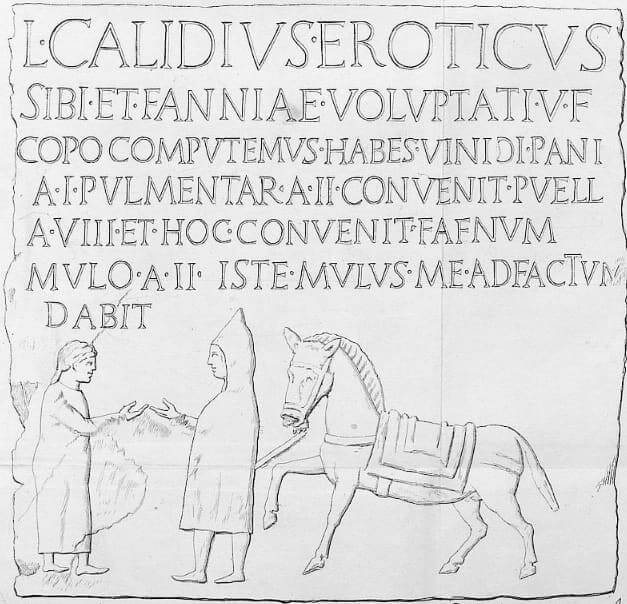
In the Italian town of Aesernia, today's Isernia, a man named Lucius Calidius Eroticus set up a stone for himself and Fannia Voluptas while he was still alive, and he had a little scene carved on it. A traveler in a hooded cloak, his mule behind him, stands facing the innkeeper, and the two hold out their hands to each other. "Copo, computemus," the dialogue on the stone begins: "Innkeeper, let's reckon up." Wine and bread for one as, a side dish for two, hay for the mule for two more, and one more item besides: every amount on the bill is cut into the stone as a Roman numeral, and the last line is a complaint about the mule. What the stone does not show is how anyone added it up.
That stone shows the two halves of Roman arithmetic that we usually run together. The reckoning happened in the hands and, for anything bigger, with pebbles on a board. The numerals came afterward, to write the result down. We are often told that Roman numerals were a clumsy way to calculate because the Romans had no zero. Our claim is that this misunderstands what the numerals were for. Roman numerals were never a calculator with a missing part. Romans calculated on counting boards and hand abacuses, where an empty column already does zero's job, and they used numerals to record results, not to work them out. Zero only becomes necessary once the written number itself is the place where you calculate, and that is what the place-value numerals that came from India made possible.
We will make the case in steps. First comes a short account of how the numerals worked and how Romans really wrote them. Then we look at where Romans did their sums, at the empty column on the board, at how later reckoners wrote "nothing" when they had to, and at what changed when the new numerals turned the page itself into the board. After that we place the argument among historians who have said related things, answer two objections and end with the places where Roman numerals still do the job they always did.
How the numerals worked
Roman numerals use seven letters: I, V, X, L, C, D and M stand for 1, 5, 10, 50, 100, 500 and 1000. Each letter has a fixed value, and a number is the sum of its letters, written from the largest down, so CCLII is 100 + 100 + 50 + 1 + 1, or 252. Several of the signs only came to look like letters over time. The Romans took their early signs for 1, 10 and 100 from the Etruscans, their neighbors to the north, and their signs for 5 and 50 changed over the centuries until 50 settled into the shape of the letter L. Karl Menninger, in his cultural history of numbers, asked whether I, V and X were "actually forms of notches cut into tally sticks," and believed that further evidence would show they were.
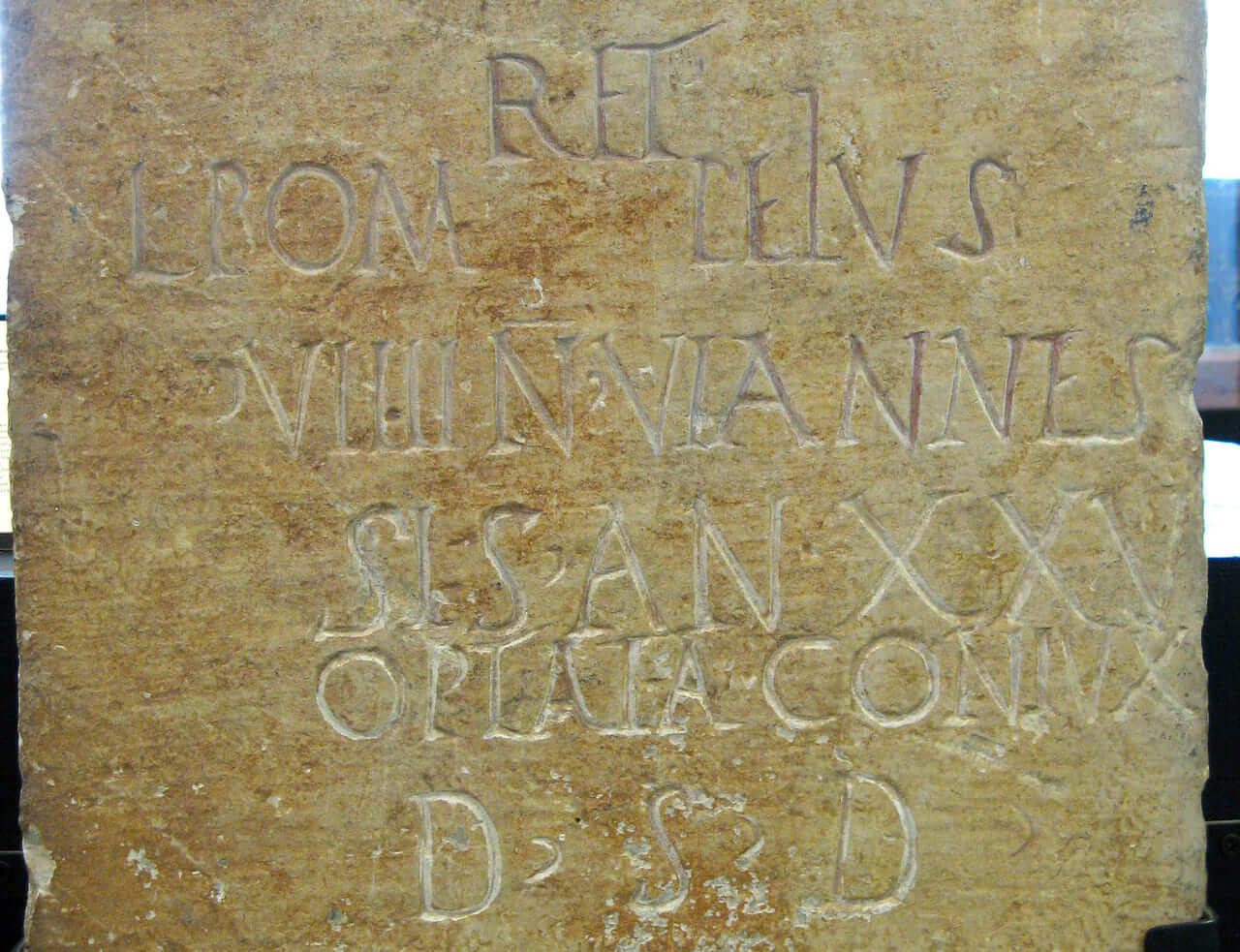
The rule that a smaller letter before a larger one is subtracted, so that IV is 4 and IX is 9, was never fixed in Roman times. Romans often wrote four as IIII, and sometimes nine as VIIII. A milestone from AD 145 near Nîmes calls the emperor Antoninus Pius consul for the fourth time, COS IIII, and the tombstone of Lucius Pompeius, a gladiator from Vienne who died at 25, counts his nine crowns as VIIII. The Etruscans had used subtraction too, in their own way: they wrote 17, 18 and 19 as "three from twenty," "two from twenty" and "one from twenty," the way they said them, but never wrote 4 as "one from five." Latin speech did the same with the high teens, so that 18 was duodeviginti, "two from twenty," and 19 was undeviginti.
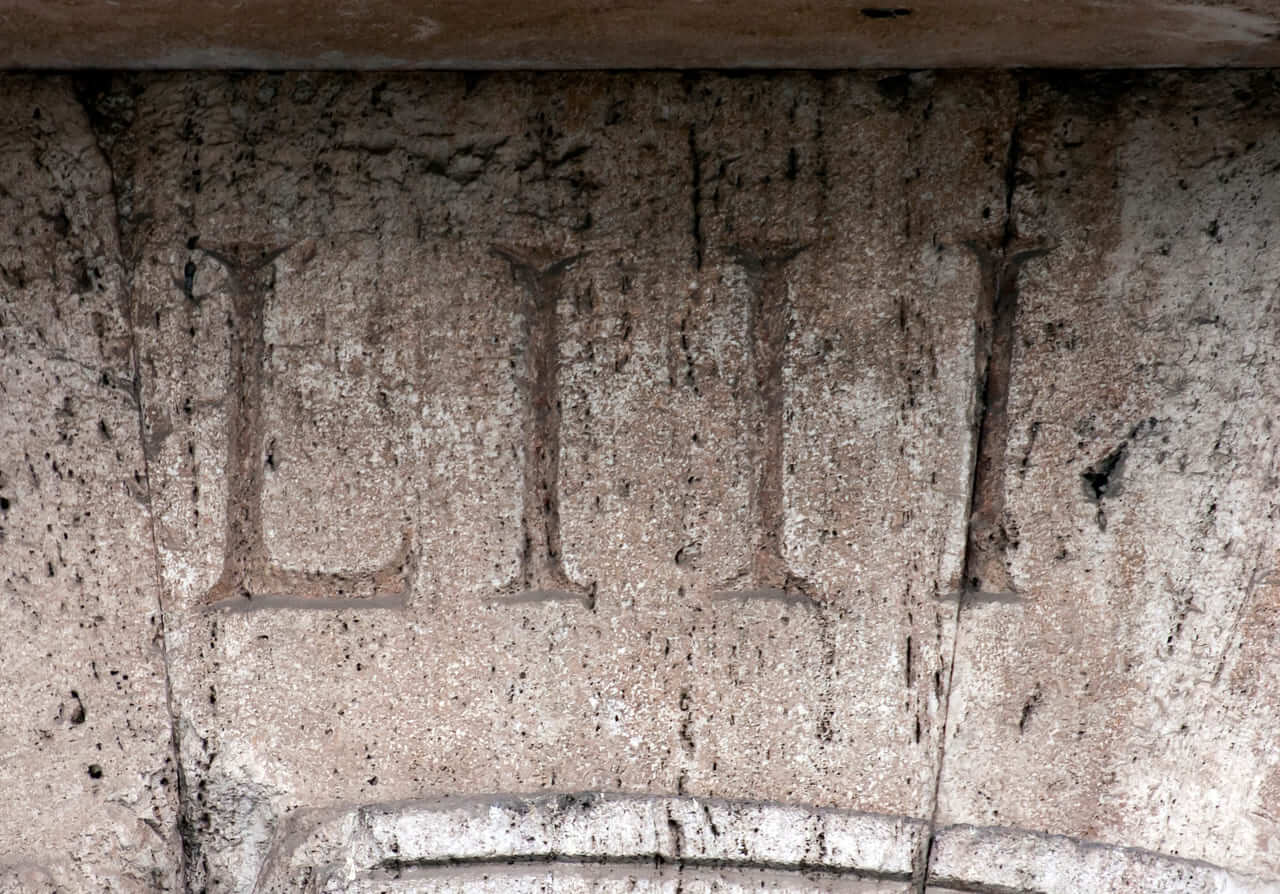
Mostly the numerals labeled and recorded things. The Colosseum, opened in AD 80, had eighty arches on the ground floor. The four at the ends of its two axes were the main entrances; the other seventy-six were numbered, with the number cut into the stone just under the architrave, and the arches from XXIII to LIV on the north side still stand. A spectator did not add or multiply those numbers. They told him which arch to walk through.
Very large numbers were awkward, and the Romans knew it. Pliny the Elder wrote that "non erat apud antiquos numerus ultra centum milia": the ancients had no number beyond a hundred thousand, so even in his day people multiplied, saying "ten times a hundred thousand" or more. There were ways around this. A bar over a numeral multiplied it by a thousand, and another notation built thousands out of C and a reversed C, so that CIↃ was 1000 and IↃ was 500.
For fractions the Romans counted in twelfths. The as, a bronze coin, and the pound, the libra, were each divided into twelve unciae, the word that gave English both "inch" and "ounce." A half was semis, written S, and smaller fractions were dots, one for each twelfth. The poet Horace describes Roman boys learning by long calculations to divide the as into a hundred parts, and gives a scrap of their drill. "If an uncia is taken from five twelfths, what is left?" "A third." "Good, you'll be able to look after your money. Add an uncia instead, what do you get?" "A half." In Horace's classroom the answers are spoken, not written.
Where the Romans did their sums
The Latin word for a counter was calculus, a little stone or pebble, and our word "calculate" comes from it. Romans spoke of setting out a sum as calculos ponere, placing the pebbles. The pebbles went on a board, a tabula, probably marked with lines for ones, tens, hundreds and so on, and the phrase was familiar enough to work as a figure of speech. In his dialogue on friendship, Cicero rejects the idea that friends should do each other exactly equal favors, calling it a mean and narrow way "ad calculos vocare amicitiam," to bring friendship to the counting board so that what was given and what was received balance out.
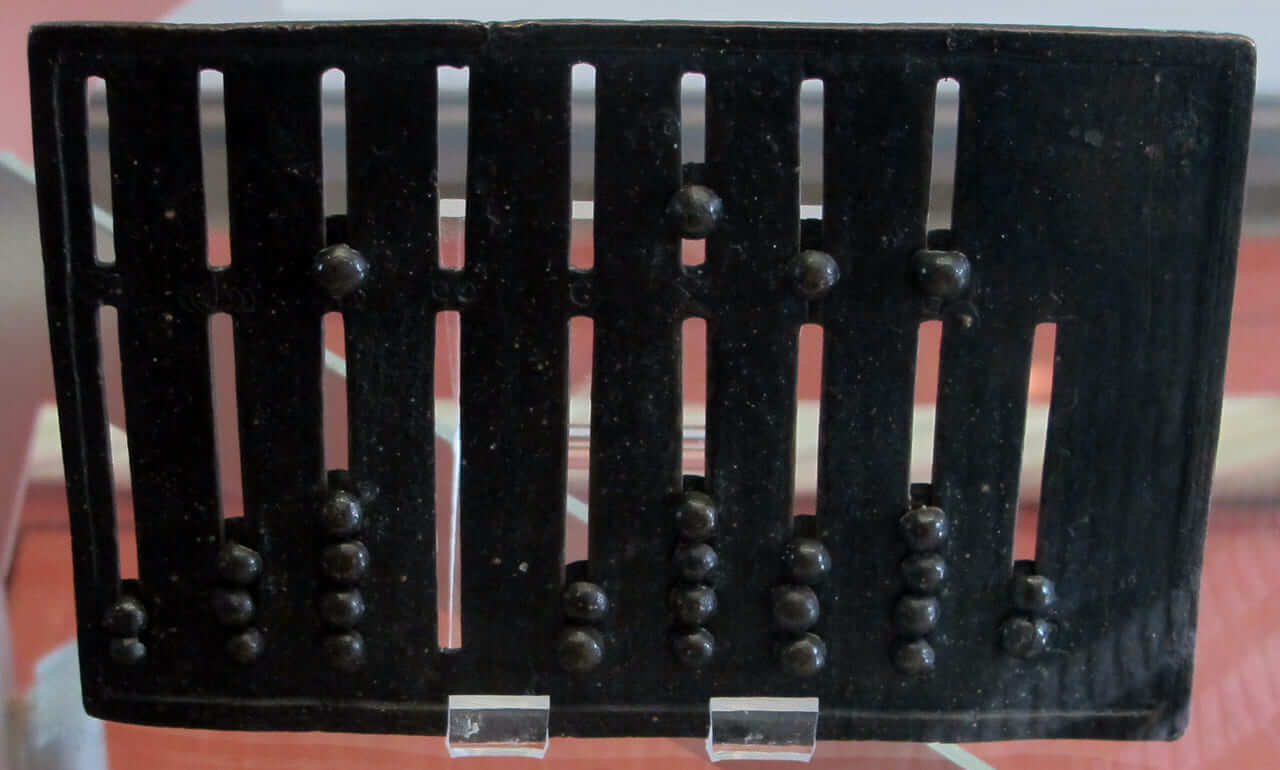
We should be honest about the evidence. The classicist J. Hilton Turner, in a 1951 article on how Romans did their arithmetic, called the board the standard instrument for any complex calculation, "a safe assumption, but an assumption based on surprisingly little direct evidence." Turner noted that no Roman counting board was known to survive, and that no Roman counters had been identified. What does survive is a pocket version: the hand abacus, a small bronze plate about five inches by three and a half, with beads that slide in slots. Each column, marked I, X, C and so on, has a long slot with four beads and a short slot with a single bead worth five, and extra slots on the right count twelfths. Only a few are known.
For smaller sums Romans had their hands. By bending and touching their fingers they could show any number up to 9999, a system that Bede wrote down in 725 and that Roman writers from Plautus to Quintilian took for granted. Turner thought the two figures on the stone from Aesernia were doing just this, their outstretched hands keeping the running total of the bill. Even a love poem could borrow the board. Catullus asks Lesbia for "basia mille, deinde centum," a thousand kisses, then a hundred, then another thousand, and then, he says, they will throw the count into confusion so that nobody knows the total, "conturbabimus illa, ne sciamus." Turner, following a reading first published in 1941, saw counters set out on the thousands and hundreds lines and then the board shaken.
The empty column
Now set a number on a board. Take 1202, the year Leonardo of Pisa finished his book on arithmetic. One pebble goes on the thousands line, two on the hundreds and two on the units. The tens line gets nothing. It is simply empty, and everyone at the table can see that it is empty. That empty line is zero, doing its whole job without any sign at all.
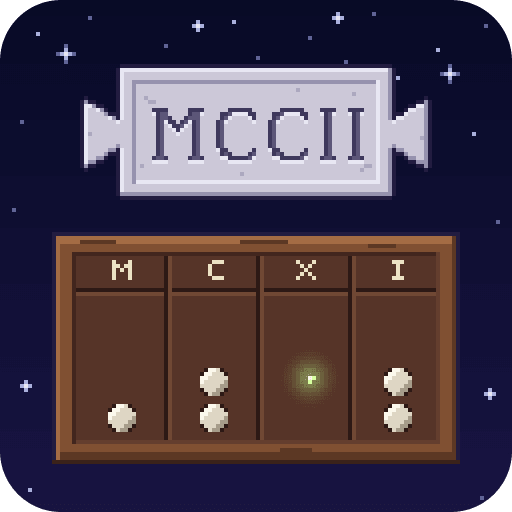
Add 98 and you push pebbles. Eight more on the units make ten, so you clear the units and carry one pebble to the tens. Nine more on the tens, plus the carried one, make ten again, so you clear the tens and carry one to the hundreds, which now hold three. The board reads one, three, nothing, nothing, and you write down MCCC. At no point did you need a mark for "nothing here," because the board kept the columns for you. And the numeral you write needs none either. MCCII does not say "one thousand, two hundreds, zero tens, two units." Its letters carry their own values, so there is no tens place to fill and nothing to leave empty. Zero is a placeholder, and a notation that has no places needs no placeholder.
The clearest sign of this comes from the man who brought the board back into Europe's schools. Late in the tenth century Gerbert of Aurillac, a monk who later became pope, had a board made for his students at the cathedral school of Reims, divided along its length into 27 parts. His student Richer described it: Gerbert set out "novem numero notas omnem numerum significantes," nine signs that signify every number, and had a thousand counters made of horn in their likeness. Nine signs, not ten. The board itself supplied the tenth.
The first Hindu-Arabic figures recorded in Latin Europe, in a manuscript of 976, were the nine from 1 to 9. In the eleventh and early twelfth centuries they were commonly marked on counters for this kind of board, and at least occasionally, as the historian C. Philipp E. Nothaft notes, reckoners added a tenth counter, called sipos, that seems to have served as a placeholder. Written arithmetic with the new figures reached Latin Europe only in the first half of the twelfth century. On the board, nine were enough.
Nothing without a numeral
Not needing a sign for zero is not the same as having no idea of nothing. When reckoners did have to write it, they used a word. In 525 the monk Dionysius Exiguus, working in Rome, drew up a table for finding the date of Easter, the same table that first counted years "from the incarnation of the Lord," the years we call AD. One of its columns gives the epact, a number that tracks the age of the moon, and in the first year of every nineteen-year cycle that column does not hold a numeral. It says nulla, "none." His rules for using the table do the same with remainders: divide the year as told, and "quod si nihil remanserit," if nothing is left over, you are in the last year of the cycle, not in a year zero.
That habit is still with us. Our way of numbering years, which goes back to Dionysius, has no year zero: AD 1 follows directly after 1 BC. A table could hold "none" and a remainder could be "nothing," but neither needed a digit, because nobody was going to calculate with the written entry. The calculating happened somewhere else.
When the page became the board
The change came from India. Indian reckoners wrote numbers with nine figures and a mark for an empty place, so that a figure's value depended on where it stood. In Sanskrit, Menninger notes, zero was called sunya, "empty," or sunya-bindu, "empty-dot": the empty column, given a name and a shape. The figures reached the Near East by the seventh century and, through Arabic, came to Europe. In 1202 Leonardo of Pisa, known today as Fibonacci, finished his Liber abbaci. He had been taught the art of "the nine figures of the Indians" as a boy in Bugia, now Béjaïa in Algeria, where his father worked in the customs house for the merchants of Pisa, and his first chapter opens with them: "These are the nine figures of the Indians: 9 8 7 6 5 4 3 2 1. With these nine figures, and with this sign 0, which in Arabic is called zephirum, any number at all is written." From zephirum came, by way of Italian, our word "zero," and from the Arabic sifr came "cipher."
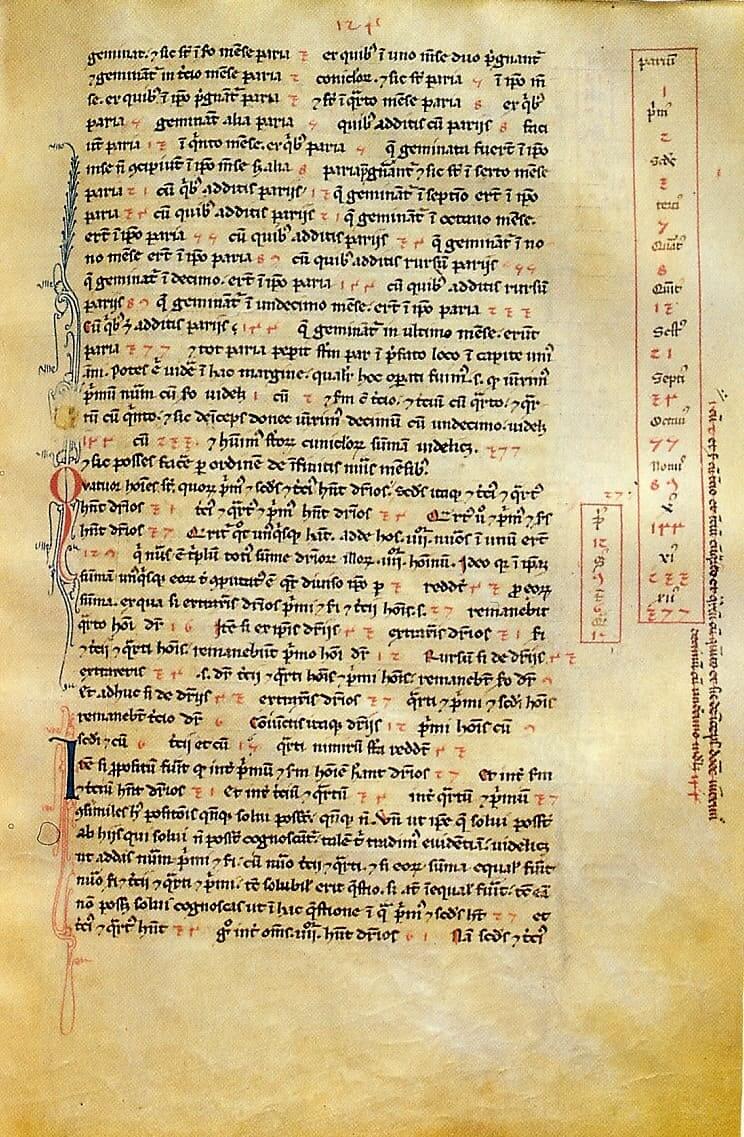
Look at what had changed. On the board, nine kinds of counter were enough, because the board kept the columns. On parchment nothing keeps the columns except the marks themselves. Write 12, 102 and 1020 without a zero and they all collapse into the same "12." The sign the board never needed became the one sign the new written arithmetic could not do without. Even the word moved. In Fibonacci's book and in the Italian schools that followed it, the abbaco no longer meant a board at all. It meant reckoning with the Indian figures on paper.
With zero on the page, the written number became the working surface. You could add, carry, multiply and divide in ink, check every step later and keep the whole calculation as a record. Menninger put the turning point exactly there: the Indian numerals "made purely written computations possible," and so won out over the counting board and the Roman numerals at the same time. The two old tools fell together because they had always worked together, one for doing and one for keeping.
The switch was slow. Latin versions of al-Khwarizmi's book on Indian reckoning circulated from the twelfth century, yet in 1518 the German arithmetic teacher Adam Ries still gave his first book to calculating "on the lines" of a board, and his book of 1522 for the apprentices of merchants and craftsmen taught reckoning "on the lines and with the pen." The anthropologist Stephen Chrisomalis dates the real abandonment of Roman numerals to the fifteenth and sixteenth centuries, with printing and wider literacy, after the new figures had been in Europe for some five hundred years.
One famous episode from the long switch is usually told wrong. In 1299 the statutes of Florence's guild of money changers, the Arte del Cambio, barred members from writing credits or debits in their account books "by means of or in the letter of the abacus," and told them to "write it openly and in full by way of letters." It was a rule about account books, repeated in the guild's revised statutes of 1300, 1313 and 1316, not a ban on the numerals themselves. The statute gives no reason. The popular story that the new figures were too easy to forge is, as Nothaft points out, nowhere in the text, and the mathematician Norman Biggs notes that the rule did not stop the bankers calculating with Hindu-Arabic numerals, which they had probably been doing for at least a century. Whatever its reason, the rule was about the record, not about how the sums were done.
We are not the first
We are not the first to separate how the Romans reckoned from how they wrote. Karl Menninger's Number Words and Number Symbols (1969 in English) gives a long part of the book to the counting board, including a section on "the counting board and written numerals." Georges Ifrah described Roman reckoning with calculi on the abacus, though he also held the common view that Roman numerals "allowed arithmetical calculation only with the greatest difficulty." Turner wrote in 1951 that the advantages of Roman numerals "are chiefly for recording," and observed that the benefit zero gives our numerals, value by position, is an advantage that "the Arabic numerals share with the abacus." Chrisomalis goes furthest: numerical notations are "principally used for representation and communication, not computation," and in antiquity "arithmetic was an embodied and material practice (e.g., on a counting board or abacus) whereas numerical notation was used for writing and recording." Norman Biggs, writing about arithmetic at the end of the thirteenth century, puts the point about zero in one line: "Even on the simplest abacus, zero could be indicated by the absence of a counter." What we add is the case built around that line. Once you see where Roman sums were done, the missing zero stops looking like a flaw in the numerals and starts looking like a job the board was already doing.
Two objections
"Didn't merchants need zero?" In the end they did, and that is our point. For centuries they managed without it because their sums were done on boards. Around 1180, the officials of England's royal treasury sat around a table about ten feet by five, covered with a black cloth "marked with stripes," and in the spaces between the stripes "are counters placed according to their values." The table, and in time the whole office, was called the Exchequer because it looked like a chessboard. The chapters of Fibonacci's book deal with buying and selling, barter, partnerships and coinage, and still, three centuries later, Adam Ries taught apprentices on the lines. Merchants needed zero when they began to do their sums in ink, which is exactly the change this article describes.
"Wasn't the system just clumsy?" For written arithmetic it is slower, and long numbers are long: 3888 is MMMDCCCLXXXVIII, fifteen letters. But it is less clumsy than its reputation. Turner showed that subtraction can even be slightly easier than with our digits: take CXXVI from CCCLXXVIII by striking out the letters they share, and CCLII is left, which is 378 minus 126. In 2008 Dirk Schlimm and Hansjörg Neth modeled addition and multiplication in both systems and found Roman numerals "computationally similar," with the cost showing up mainly in the number of symbols to handle. As Chrisomalis puts it, they "just aren't nearly as awful as we've been conditioned to believe." And the comparison misses the Roman setup anyway. Nobody was meant to multiply MMMDCCCLXXXVIII in ink. The pebbles did the multiplying.
Where the numerals still live
Roman numerals never left the jobs Rome gave them. Chrisomalis notes that we keep them for "counting things we really value, such as kings, popes, and Super Bowls." The habit of numbering kings became general in England under Henry VIII, and popes are numbered the same way, down to Leo XIV. The National Football League put a Roman numeral on Super Bowl V in 1971 and has done so ever since, with a single exception: Super Bowl 50 in 2016, because "L" did not look good on the logo. The league went back to Roman numerals with Super Bowl LI the next year. Films and television shows often give the year they were made in Roman numerals, books number the pages of their prefaces and introductions with them, and outlines use them to number their headings.
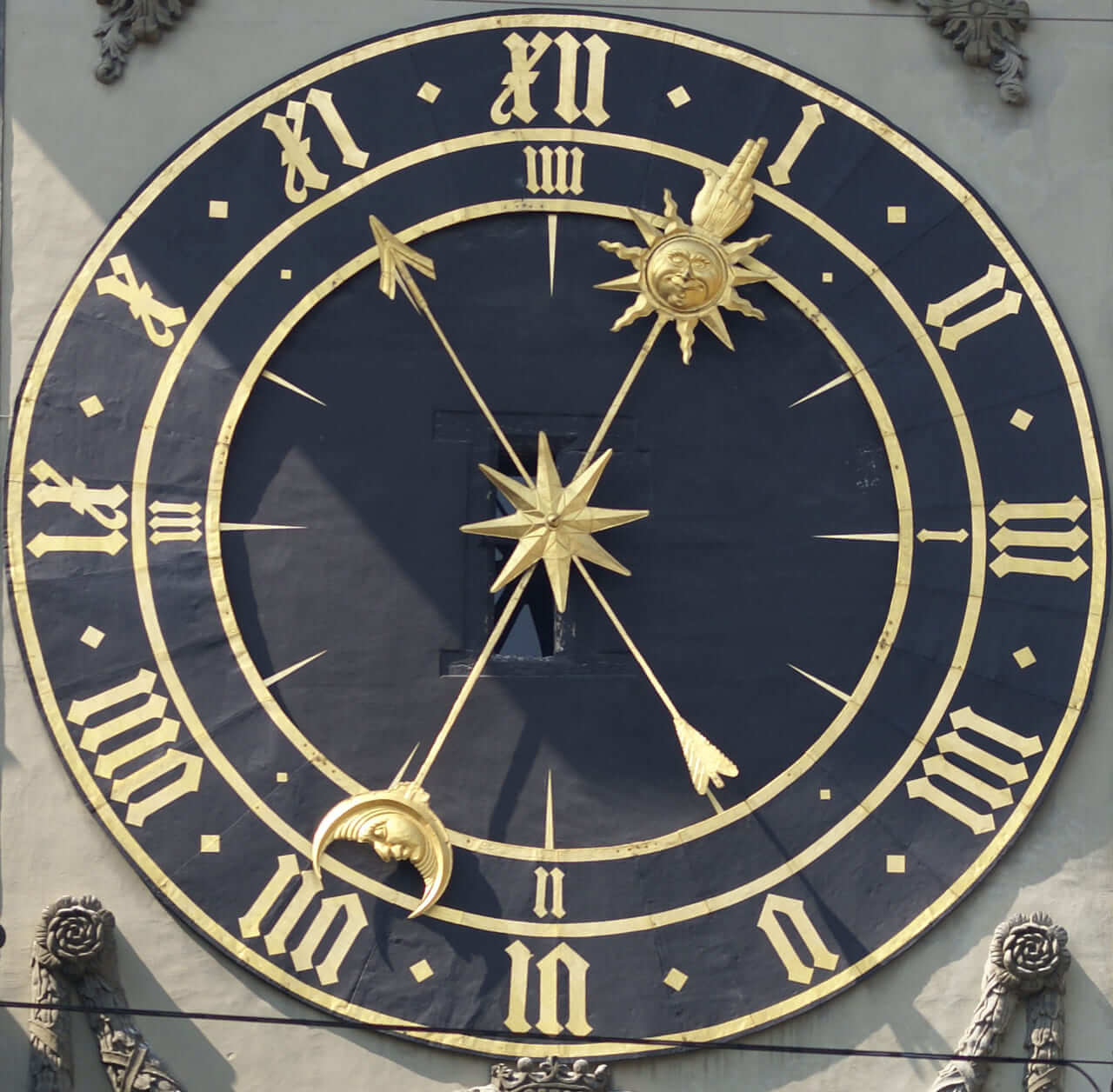
And then there are clocks, where four o'clock is so often IIII. The Seiko Museum in Tokyo lists the theories, from a French king who thought IV unlucky to the clock of Wells Cathedral, built at the end of the fourteenth century, which used IIII and set a fashion. It notes that IIII was the usual way to write four in medieval Europe until around the seventeenth century, and that the most popular explanation is simply that IIII looks better balanced on a round dial. Whatever the reason, a clock face keeps the old Roman habit. In every one of these places the numerals label, count or record something. Nobody adds them up.
Nothing to write down
Go back to the inn at Aesernia. The traveler and the innkeeper did not lack anything. They reckoned with their hands, the way Romans reckoned with pebbles and beads when the sums got bigger, and when the bill was settled the stone recorded the result in a handful of letters. In that arrangement zero has no work to do. The board shows the empty column, and the numeral simply leaves it out. Zero became essential only when Europe began to calculate on the same page it wrote on, and the Hindu-Arabic numerals that made that possible replaced both of the old tools at once, the board and the letters. The Romans were not missing a digit. They were keeping their working and their writing in two different places.
Our own app Roman Decimals sits on the writing side. It converts both ways between Roman numerals and decimal numbers, from 1 to 3999 in the standard form, and if you type 0 it answers Invalid, because there is no Roman numeral to give. Read about Roman Decimals
Have you spotted a IIII on a clock, or a Roman numeral somewhere unexpected? Tell us
Sources :
- The stone from Aesernia: the Louvre's record of the inscription (opens in a new tab), the 1848 drawing on Wikimedia Commons (opens in a new tab)
- Roman numerals and the hand abacus: Roman numerals on Wikipedia (opens in a new tab), Roman abacus on Wikipedia (opens in a new tab), calculus (opens in a new tab), duodeviginti (opens in a new tab) and undeviginti (opens in a new tab) on Wiktionary
- Roman everyday arithmetic: J. Hilton Turner, "Roman Elementary Mathematics: The Operations" (The Classical Journal, 1951) (opens in a new tab)
- Latin texts: Pliny the Elder, Natural History 33 (opens in a new tab), Horace, Ars Poetica (opens in a new tab), Cicero, De Amicitia (opens in a new tab), Catullus (opens in a new tab), Richer of Reims, Histories, book 3 (opens in a new tab) (The Latin Library)
- Inscriptions: the Colosseum in Platner and Ashby's Topographical Dictionary of Ancient Rome (opens in a new tab), Colosseum on Wikipedia (opens in a new tab), the tombstone of Lucius Pompeius (opens in a new tab), the milestone of Antoninus Pius (opens in a new tab) (Wikimedia Commons)
- Dionysius Exiguus: his Easter table and rules, with Michael Deckers' translation (opens in a new tab), Anno Domini on Wikipedia (opens in a new tab)
- Gerbert: Gerbert of Aurillac on MacTutor (opens in a new tab)
- Fibonacci: Il Liber abbaci di Leonardo Pisano (opens in a new tab) (Baldassarre Boncompagni's edition, 1857, Internet Archive), Fibonacci on MacTutor (opens in a new tab), the manuscript page on Wikimedia Commons (opens in a new tab)
- Hindu-Arabic numerals in Europe and the Florentine statute: C. Philipp E. Nothaft, "Medieval Europe's Satanic Ciphers: On the Genesis of a Modern Myth" (British Journal for the History of Mathematics, 2020) (opens in a new tab) and its open copy at Oxford (opens in a new tab), Norman Biggs, "Mathematics of Currency and Exchange: Arithmetic at the End of the Thirteenth Century" (LSE, 2008) (opens in a new tab)
- Reckoning boards later on: The Dialogue Concerning the Exchequer (opens in a new tab) (The Avalon Project), Adam Ries on Wikipedia (opens in a new tab)
- Historians: Karl Menninger, Number Words and Number Symbols (opens in a new tab), Georges Ifrah, The Universal History of Numbers (opens in a new tab), "Re-counting the Cognitive History of Numerals," an interview with Stephen Chrisomalis (opens in a new tab) (The MIT Press Reader), Dirk Schlimm and Hansjörg Neth, "Modeling Ancient and Modern Arithmetic Practices" (2008) (opens in a new tab)
- Roman numerals today: Super Bowl 50 on NPR (opens in a new tab), IIII on clock dials at the Seiko Museum (opens in a new tab)
- Images: the hand abacus (opens in a new tab), arch LIII of the Colosseum (opens in a new tab), the Zytglogge dial (opens in a new tab) (Wikimedia Commons)
The photograph of the hand abacus is by Sailko under CC BY-SA 3.0, and the photograph of Lucius Pompeius's tombstone is by Mark Landon under CC BY 4.0. David Castor's photograph of the Colosseum is dedicated to the public domain (CC0), and Sandstein's photograph of the Zytglogge dial is in the public domain. The 1848 drawing of the stone from Aesernia and the page of Liber abbaci are in the public domain. The English versions of the Latin passages are our own translations, except the Florentine statute, quoted in Dirk Struik's translation as Nothaft gives it, and the Dialogue Concerning the Exchequer, quoted in Ernest F. Henderson's translation. The pixel-art illustration at the top is our own.
If you like this article,