PDF at 33 : How a 1993 Format Outlived Its Rivals
On June 16, 1993, Marc Andreessen, a student at the National Center for Supercomputing Applications in Illinois who worked on its Mosaic web browser, forwarded a news story to www-talk, a mailing list about the young World Wide Web. The day before, at a news conference in New York, Adobe had launched Acrobat, a set of programs built around a new kind of file, the Portable Document Format. Above the story Andreessen added a question: did anyone know if there were "available specs for PDF" yet?
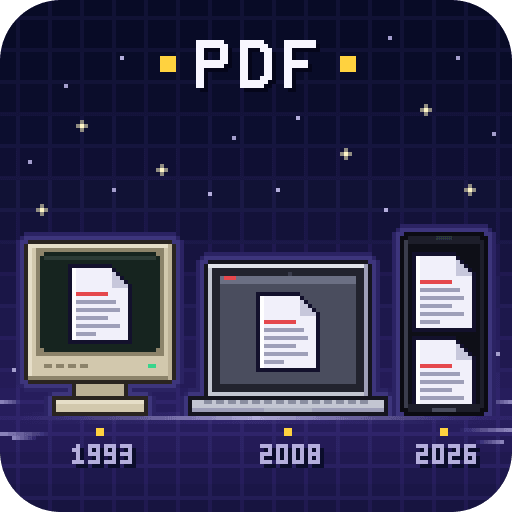
There were. That same month Adobe published the PDF specification as a book, written so that other programmers could make PDF files without Adobe's software. Thirty-three years later the format Andreessen asked about is everywhere: Adobe says people opened more than 400 billion PDFs in its Acrobat products in 2022, about twice the figure it gave in 2018. The formats launched against it are history; one of them, Common Ground, is now an item in the collection of the Computer History Museum.
Most histories of PDF credit John Warnock's vision and Adobe's decision to give away its reader. This article argues something narrower. PDF outlived its rivals because it kept one promise, that a document looks the same on every screen and every printer, and because Adobe gave away the parts that mattered, in order: the specification in 1993, so anyone could write PDFs; the reader in 1994, so anyone could open them; and finally the format itself, handed to the International Organization for Standardization (ISO) and published as a standard in 2008. The free reader gets most of the credit, but rivals gave their viewers away too, and one of them did it before Adobe. What none of them gave away was the format.
We start with PostScript and the short paper that became PDF, then follow Acrobat's slow start, the rivals, the free reader, the tax forms that gave people a reason to install it, the browser years and the standards that turned PDF into public property. After that come the format's real weaknesses, a note on who has told this story before, two objections and a closing word.
PostScript: a page as a program
Adobe began in December 1982, when Warnock and Chuck Geschke left Xerox's Palo Alto Research Center to start a company around a new printing language. Released in 1984, PostScript described a page as mathematics, so text and images could be scaled, rotated and printed at the best quality any printer could manage. It was a complete programming language, and Adobe published its details so that others could build compatible products. It became a de facto standard and set off the boom in desktop publishing. In 1985, when Steve Jobs unveiled Apple's LaserWriter, one of the pages he printed on stage was a federal 1040 tax form that Warnock had recoded in PostScript with a graphics program of his own, the program that would later become Acrobat Distiller.
A program, though, is a heavy thing to send someone. To show a PostScript page, a computer has to run it. PostScript worked well inside printers, but on screens it ran only on systems built around Display PostScript, and, as Warnock wrote, that route "requires powerful desktop machines and PostScript printers." Most people's computers were nothing of the kind. PDF's answer, as Warnock later put it, was to run the program once and keep only the result: "Everything is now a data structure as opposed to a program." The first PDF manual said it plainly: "A PDF file is not a PostScript language program."
The Camelot paper (1990)
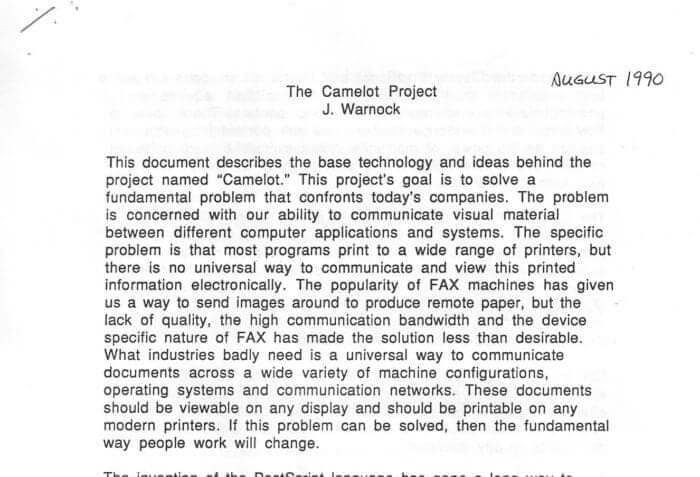
In the summer of 1990, Warnock wrote a six-page paper called "The Camelot Project." It opens with a business problem: most programs could print to all sorts of printers, "but there is no universal way to communicate and view this printed information electronically." Fax machines moved pages around, but in poor quality and tied to the machine. What industries needed, he wrote, was a universal way to send documents across machines, operating systems and networks: "These documents should be viewable on any display and should be printable on any modern printers. If this problem can be solved, then the fundamental way people work will change."
His plan was to run any PostScript file through a small interpreter that recorded only what it drew, and to write out a simpler file carrying just the characters of each font the document used, so that it would be "completely self contained." A small viewer would show these files on the ordinary PCs of the day, down to 640K machines with CGA screens. He imagined newspapers and manuals sent by email, encyclopedias and maps on CD-ROM, text search across documents, and a future in which "Entire libraries could be archived in electronic form."
The paper also shows what Warnock did not yet plan to do: give anything away. "Components of Camelot are generally not interesting to single users," he wrote; companies would want a viewer on every PC, and "corporations should be interested in site-licensing arrangements." The giveaway came later, after the market had pushed back.
Acrobat 1.0: a hard sell (1993)
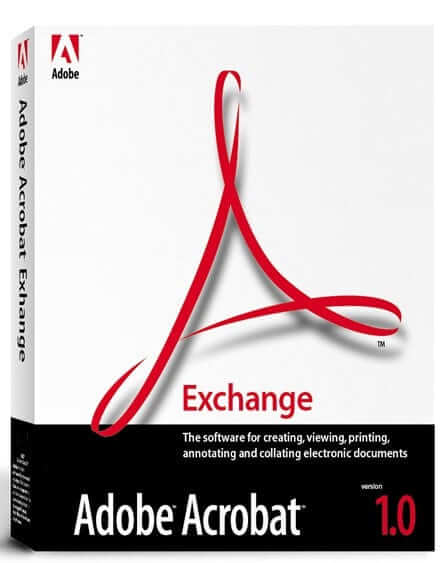
Adobe launched Acrobat on June 15, 1993, at the Equitable Center in New York, with three programs: Acrobat Exchange to make and view PDFs, Acrobat Reader to view them, and Acrobat Distiller to turn PostScript files into PDF. Every part cost money. The wire report Andreessen forwarded gave the prices: $695 for Distiller, $195 for a single copy of Exchange, and $35 a copy for Reader in orders of more than 500. The same month, Addison-Wesley published Adobe's Portable Document Format Reference Manual, written, its introduction said, "primarily for application developers who wish to produce PDF files directly."
The start was slow. Acrobat's recommended setup was a 486 PC with 8 MB of memory, a big machine in 1993. Adobe did not have the licenses to ship every font with a document, so Acrobat stored each font's measurements and, when a reader lacked the font, built a stand-in that fit exactly the same space: the layout stayed true, even when the letters were an approximation. Links inside a PDF could not yet reach the internet. "When Acrobat was announced, the world didn't get it," Warnock said in 2010. Someone from the Gartner Group called it the dumbest idea they had ever heard, and Adobe's own board "wanted to kill it."
Rivals with free viewers
Acrobat was not alone. In July 1993 Farallon announced Replica, a rival built on TrueType fonts instead of PostScript, and in one respect it was ahead: Farallon let anyone copy and share its viewer for free, "whereas Acrobat viewer costs money," as the trade paper Computer Business Review put it. No Hands Software's Common Ground, also from 1993, promised pages identical pixel for pixel at 300 dpi; the copy in the Computer History Museum still has its floppy disk, its user guide and a paper on how it differed from Adobe Acrobat. Envoy shipped with WordPerfect Office in 1994 and belonged to Novell by 1995. That year Envoy had a free viewer, Netscape and Spyglass promised to support it in their browsers, and Novell summed up the market: "Success in the portable document market requires free document viewing tools."
So a free viewer was not what set PDF apart. The difference was on the other side of the file. "While only Envoy owners can publish an Envoy document, the viewer is available free," Novell explained. PDF's specification had been public from the first month, so any company could write PDFs without asking Adobe, and Distiller could turn the print output of almost any program into PDF. On PDF's 30th birthday, Adobe put it in one line: "If an application could print reliably, it could create PDFs reliably!" Warnock saw the same advantage: because Distiller could convert any PostScript file, "we don't have to ask anybody's permission."
The free reader (1994)
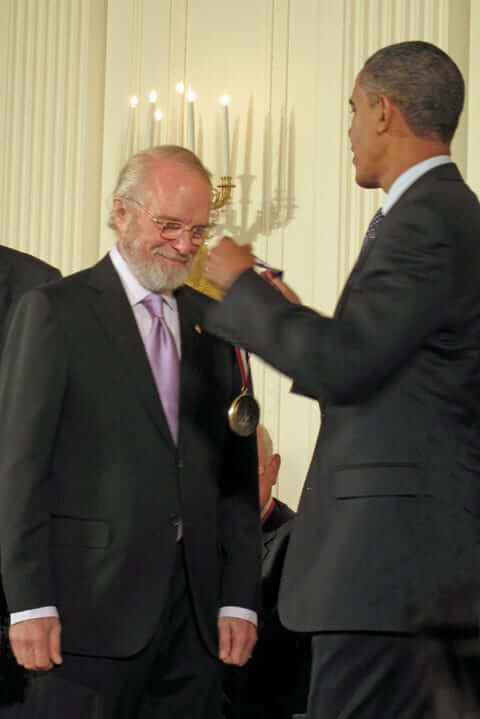
Adobe followed in 1994. With Acrobat 2.0, Acrobat Reader became free, able to view, navigate and print any PDF, "a welcome change from Acrobat 1.0," as TidBITS reported, and Acrobat 2.0 promised links that could reach out over the internet. Warnock later called it a "very risky choice": from then on, Adobe could make money only from the tools that create PDFs. It paid off. By 2006 Adobe counted well over 500 million copies of the free Reader distributed around the world.
The free reader and the open specification worked as a pair. Others could write PDFs because the format was published; anyone could read them because the reader was free; and every PDF that anyone made was one more reason to install the reader. The PDF Association, the nonprofit that now runs the secretariat of the ISO committee responsible for most PDF standards, calls that early openness decisive. Developers could read and implement every version from PDF 1.0 to 1.7, and "This freedom was critical to PDF's success."
Forms from the tax man (1994)
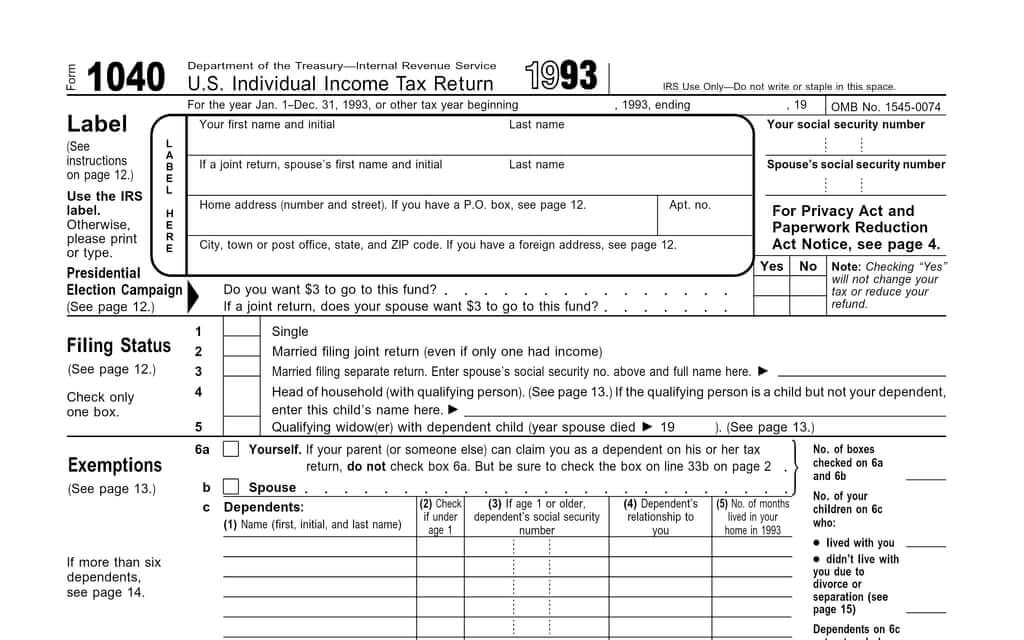
People still needed a reason to open a PDF, and one of the first came from the Internal Revenue Service. In February 1994, Maxwell Laboratories, working with the IRS, announced tax forms on the internet for filing 1993 returns, with "all current IRS products (more than 700 in all) in Adobe PDF." A tax form is the kind of document where layout is the point: the boxes, lines and numbers have to match the printed original, and that was exactly what PDF promised. It also closed a circle. Nine years earlier, a 1040 had been Warnock's showpiece for PostScript.
The browser years (1996 to 2013)
The web arrived at the same time as PDF, and at first the two did not fit together. In 1996 Adobe released test versions of Amber, a plug-in that showed PDFs right inside Netscape's window, along with a new way of saving PDFs for the web. A linearized PDF, a feature of PDF 1.2 designed for the web, puts the first page first and adds hints for finding the rest, so a server can send a document one page at a time instead of all at once. Acrobat offers this as Fast Web View, for "page-at-a-time downloading (byte-serving) from web servers." Until 2010, reading a PDF in a browser usually meant a plug-in, Adobe's or someone else's.
Plug-ins brought, in Google's words, "challenges in compatibility, performance, and security." In June 2010 Google began building a PDF viewer into Chrome itself, inside the same security sandbox as web pages, so that "PDF files will render as seamlessly as HTML web pages." A year later Andreas Gal of Mozilla announced PDF.js, a PDF reader written in JavaScript, in the hope that it would allow "web technologies to subsume PDF." In February 2013 it became the built-in PDF viewer of Firefox 19.
The result was the opposite of subsuming. Once browsers opened PDFs by themselves, nobody needed Adobe's software, or any extra software, to read one. The reader Adobe gave away in 1994 had, by 2013, become something people no longer had to install at all. The format had outgrown its maker.
Standards for print, archives and access (2001 to 2012)
As PDF spread, the industries that relied on it agreed on stricter forms of it, published by ISO. PDF/X, from 2001, is for printing: PDF files of CMYK data that are "complete and ready for final print reproduction." PDF/A, from 2005, is for archives: a restricted form of PDF 1.4 in which, among other rules, every font must be embedded, so a file never depends on what the reader's computer has installed. PDF/UA, from 2012, is for accessibility: it specifies how to make PDFs that people with disabilities can use. Adobe had worked in ISO groups on such standards since 1995.
Archives took to PDF/A. In 2014 the US National Archives named PDF/A-1 a preferred format for the textual records transferred to it, according to the Library of Congress. Warnock's line about entire libraries archived in electronic form came true, in a shape his paper did not foresee: through an international standard that Adobe did not control.
Handing over the format (2007 to 2023)
The largest giveaway came in 2007. On January 29, Adobe announced that it would release the full PDF 1.7 specification to AIIM, an industry association, for publication by ISO. Kevin Lynch, Adobe's chief software architect, called it the step "from de facto standard to a formal, de jure standard." ISO published it as ISO 32000-1 in July 2008. From then on, PDF was defined by a public standard rather than by one company's manual.
Adobe's own rules on versions had already made PDF a safe bet. Its PDF manual set the goal that any Acrobat viewer "should be able to display the contents of any PDF file, even if the PDF file was created long before or long after the viewer application," and Adobe raised the major version number only for changes that old readers could not handle. For 24 years the major version stayed at 1. PDF went from 1.0 in 1993 to 1.7, and PDF 2.0, ISO 32000-2, arrived only in 2017, the first PDF standard developed entirely in a vendor-neutral forum. The Camelot paper itself, saved as a PDF in 1995, still opens in today's browsers.
One last episode shows how much the openness mattered. PDF 2.0 was the first core PDF specification sold only by ISO, and for five years, the PDF Association says, that price tag was "inhibiting its use and adoption." In April 2023 the association, with Adobe, Apryse and Foxit as sponsors, made it free to download. Thirty years after Andreessen asked for the specs, the answer had to be given again.
What people dislike about PDF
PDF has strong critics, and they are right about a lot. Jakob Nielsen of the Nielsen Norman Group, which studies usability, has warned since 1996 against making people read PDFs online: "The format is intended and optimized for print." On a phone, a page sized for paper means zooming in and out and scrolling in both directions; the UK's Government Digital Service noted in 2018 that "PDFs are not designed to be flexible in their layout." A PDF's accessibility depends on how it was made, it is harder to update than a web page, and copying text out of a multi-column layout can scramble it. GOV.UK still had about 200,000 PDFs then, and publishers were adding tens of thousands a month.
PDF has answers, but they depend on the author. Tagged PDF, added in PDF 1.4, records a document's structure so that text can reflow to fit a smaller page and assistive technology can read it in order, and PDF/UA sets the rules for doing that well. As the Nielsen Norman Group points out, authors who export a PDF straight from a word processor rarely take that care.
And yet the critics keep PDF for one job. After its 2018 post drew wide debate, GOV.UK added that a PDF still has a place "when there's a need for a static document to show what was said at a particular point in time." That is Warnock's promise seen from the other side: a document that looks the same everywhere is also a document that stays the way it was. The property that makes PDF awkward on a phone is the same one that makes it trusted for a contract, a thesis or a tax return.
We are not the first
PDF's story has been told many times. Adobe tells it as a story of invention, in its posts for Acrobat's 25th and 30th anniversaries. David C. Brock's history of PostScript for the Computer History Museum traces the ideas back to Warnock's years at Xerox PARC. The PDF Association's 2025 milestones poster, by Peter Wyatt, follows PDF from Adobe's specifications into ISO standards. Ernie Smith's history on Tedium, first written in 2018, says that making the reader free "ultimately proved the key to Adobe's success." We agree with all of them on the facts. Where we differ is on the key. The record from 1993 to 1995 says the free reader was necessary but not enough, because Adobe's rivals had free viewers too. What they lacked was a format that anyone could write.
Two objections
"PDF survived only because Adobe was big." Size helped. In 1990, Warnock counted more than 100 printer models with Adobe's PostScript inside and over 4,000 applications that printed to it, and Distiller turned that reach into a supply of PDFs. But size alone has not saved a format. Microsoft, the maker of Windows, built its own page format, XPS, gave Windows a viewer for it and saw it become an Ecma standard, OpenXPS, in 2009; with Windows 10 version 1803, in 2018, new installations stopped including the XPS Viewer. XPS was open, too, but it arrived in a world that already ran on PDF. Adobe itself owned Flash and ended support for Flash Player on December 31, 2020. What PDF had was not only size but openness from the start, before any rival could take its place.
"PDF is a bad format for the web." For reading on a screen, often yes, and the critics above make the case well. But PDF was never meant to be a web page. It is a page: a record of how a document looked when it was finished. The web took over PDF's viewer, as Andreas Gal hoped, without replacing what the file is for.
The page that stays put
Andreessen asked the right question in 1993. A format lives or dies by whether other people can build on it, and Adobe's answer was yes: it published the book that month, gave the reader away the next year, and handed the whole format to ISO fifteen years later. Each step gave away a little more control and won a little more trust. In 1990, Warnock wrote that if the problem of sending a document anywhere could be solved, "then the fundamental way people work will change." It was solved, the way people work did change, and thirty-three years on, the page still looks the same.
We make PDFs too. PDFGen, our free web app, makes PDFs from images, PDFs and Markdown text right in your browser: your files are never uploaded, and once you have opened it online it works offline too. It reads PDFs with Mozilla's PDF.js and writes them with its own code, which is possible only because the PDF specification is open to everyone.
Did we miss a part of PDF's story? Tell us
Sources :
- The Camelot paper: John Warnock, "The Camelot Project" (PDF) (opens in a new tab), the PDF Association on the paper (opens in a new tab), Adobe on Acrobat's 25th anniversary (opens in a new tab)
- PostScript: David C. Brock, "PostScript: A Digital Printing Press" (Computer History Museum, 2022) (opens in a new tab)
- Acrobat 1.0: Marc Andreessen's message and the UPI story (www-talk, 1993) (opens in a new tab), NCSA Mosaic (opens in a new tab), Portable Document Format Reference Manual (Adobe, 1993, PDF) (opens in a new tab), John Warnock interviewed by Knowledge at Wharton (2010) (opens in a new tab)
- The rivals: Replica in Computer Business Review (1993) (opens in a new tab), Common Ground at the Computer History Museum (opens in a new tab), Common Ground at the Centre for Computing History (opens in a new tab), Envoy on Wikipedia (opens in a new tab), Novell on Envoy publishers (opens in a new tab), Novell on Envoy in Netscape and Spyglass (1995) (opens in a new tab)
- The free reader: "Acrobat flips to 2.0" (TidBITS, 1994) (opens in a new tab), PDF Reference, sixth edition (Adobe, 2006, PDF) (opens in a new tab), Adobe on Acrobat's 30th anniversary (opens in a new tab)
- The IRS: "IRS Tax Forms Available On Internet" (HPCwire, 1994) (opens in a new tab), Form 1040 for 1993 (IRS, PDF) (opens in a new tab)
- The browser years: "Alpha Acrobat Plug-In Available" (TidBITS, 1996) (opens in a new tab), Adobe on Fast Web View (opens in a new tab), Chrome's PDF viewer (2010) (opens in a new tab), Andreas Gal's announcement of PDF.js (2011) (opens in a new tab), Firefox 19 release notes (opens in a new tab)
- Standards: ISO 15930-1 (PDF/X) (opens in a new tab), ISO 19005-1 (PDF/A) (opens in a new tab), ISO 14289-1 (PDF/UA) (opens in a new tab), the Library of Congress on PDF/A-1 (opens in a new tab), Adobe's 2007 announcement (The XML Cover Pages) (opens in a new tab), ISO 32000-1 (opens in a new tab), ISO 32000-2:2017 (opens in a new tab), no-cost access to PDF 2.0 (PDF Association, 2023) (opens in a new tab)
- The critics: Jakob Nielsen and Anna Kaley, "PDF: Still Unfit for Human Consumption, 20 Years Later" (Nielsen Norman Group, 2020) (opens in a new tab), Neil Williams, "Why GOV.UK content should be published in HTML and not PDF" (2018) (opens in a new tab)
- XPS and Flash: XPS documents (Microsoft) (opens in a new tab), ECMA-388 (OpenXPS) (opens in a new tab), features removed from Windows (Microsoft) (opens in a new tab), Flash Player's end of life (Adobe) (opens in a new tab)
- Other histories: Ernie Smith, "PDF Format History" (Tedium) (opens in a new tab), "A Timeline of Innovation" (PDF Association, 2025) (opens in a new tab)
- Image: John Warnock receives the National Medal of Technology and Innovation (Wikimedia Commons) (opens in a new tab)
PDF is an open standard, ISO 32000. Adobe, Acrobat, PostScript, Reader and Flash are trademarks of Adobe; Windows is a trademark of Microsoft, and Firefox of the Mozilla Foundation; other names are trademarks of their owners. The scan of the Camelot paper and the Acrobat Exchange 1.0 box are © Adobe and come from Adobe's blog. Form 1040 is a work of the US government and in the public domain; our image is a rendering of the IRS's own PDF. The photo of John Warnock is by Schmiebel, who released it into the public domain (CC0) on Wikimedia Commons. The pixel-art illustration at the top is our own.
If you like this article,