10 Puzzles to Play After Sudoku : From Kakuro to KenKen
In August 1980 the first issue of Nikoli came out in Tokyo: the first puzzle magazine in Japan. Its founder, Maki Kaji, borrowed two number puzzles from American magazines: Cross Sums, which he renamed Kakuro, and Number Place, which became sudoku in 1984. Then he opened a section for puzzles his readers invented themselves, and it soon became the most popular part of the magazine. Atlas Obscura describes Nikoli as "created almost entirely by its readers": in 2022 it was receiving about 4,000 puzzles a year from around 300 regular contributors, and in 40 years it had published some 500 new kinds of grid puzzle.
If you like sudoku, you already like what makes these puzzles work: a grid, a few simple rules, a single solution and no guessing. These are the ten logic puzzles we think a sudoku player will enjoy most next: the classics that newspapers, magazines and apps keep coming back to, and that are easy to find today. Six of them were born in Nikoli's magazine. They are in order of first publication, and each one comes with a small example of our own, checked to have exactly one solution, then the rules in plain words, where it came from and where to play it now. Seven of them are also in Simon Tatham's Portable Puzzle Collection, a free, open-source set of puzzle games for computers that also runs in a browser, often under names of its own. At the end there is a bonus for when you come back to sudoku.
1. Kakuro
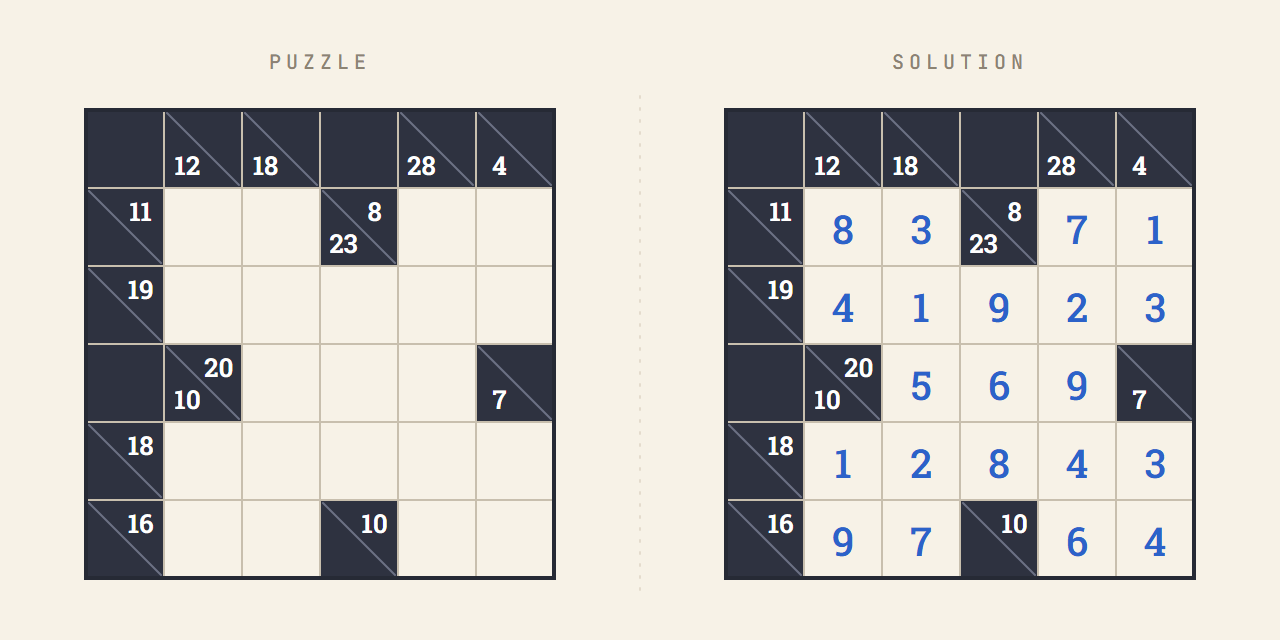
Kakuro is a crossword made of digits. Each run of white cells is an entry, and its clue sits in the dark cell just before it: to the left of an entry across, above an entry down. Fill every white cell with a digit from 1 to 9 so that each entry adds up to its clue, without repeating a digit within an entry. The way in is that some sums can be made only one way: 4 in two cells has to be 1 and 3, and 23 in three cells has to be 6, 8 and 9. Both are in the example above.
Kakuro began in America. Jacob E. Funk, a Canadian, created it around 1950 as Cross Sums, and it became a favorite in Dell's puzzle magazines in the United States. When Maki Kaji brought it to Nikoli, it became kasan kurosu, "addition cross", shortened to Kakuro. In 1984, when Nikoli first printed sudoku, its readers still liked Kakuro better, and Kakuro stayed the most popular logic puzzle in Japanese print until sudoku overtook it in 1992.
- Invented by: Jacob E. Funk, as Cross Sums
- First printed: around 1950, in Dell's puzzle magazines in the United States
- Play it today: in puzzle magazines and newspapers, in Puzzle by Nikoli S Kakuro on Nintendo Switch, and free in a browser at puzzle-kakuro.com
2. Nonograms
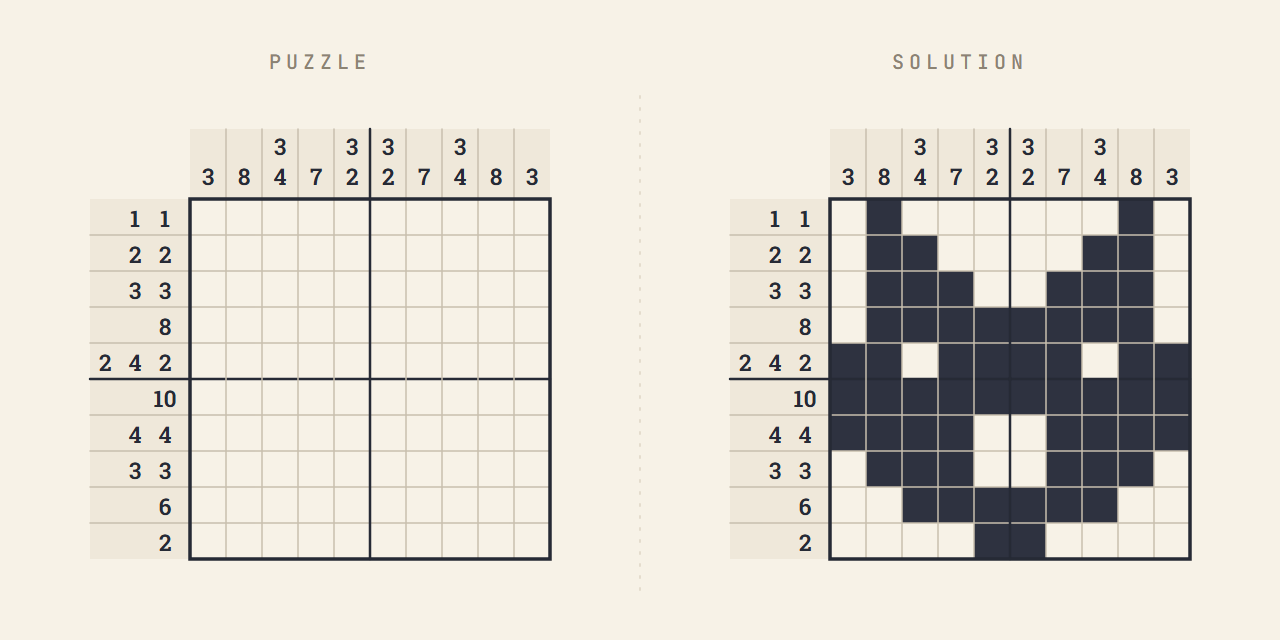
A nonogram is a picture hidden in a grid. The numbers beside each row and above each column give the lengths of the runs of filled cells in that line, in order, with at least one empty cell between two runs: "3 3" means three filled cells, a gap, then three more. Work out line by line which cells must be filled and which must stay empty, and the picture appears. Ours is a cat.
In 1987 Non Ishida, a Japanese graphics editor, won a competition in Tokyo with pictures made by switching a skyscraper's lights on and off, and it gave her the idea for a puzzle. A professional puzzle maker, Tetsuya Nishio, came up with the same idea on his own. Ishida published her first three Window Art Puzzles in 1988, and James Dalgety, a British puzzle collector, named them nonograms after her. The Sunday Telegraph printed one every week from 1990. Nintendo trademarked the name Picross, short for "picture crossword", and brought the puzzle to the Game Boy in 1995 with Mario's Picross.
- Invented by: Non Ishida, and on his own Tetsuya Nishio
- First printed: Japan, 1988, as Window Art Puzzles
- Play it today: Jupiter's Picross S games on Nintendo Switch, Pattern in Simon Tatham's collection, and free at puzzle-nonograms.com
3. Slitherlink
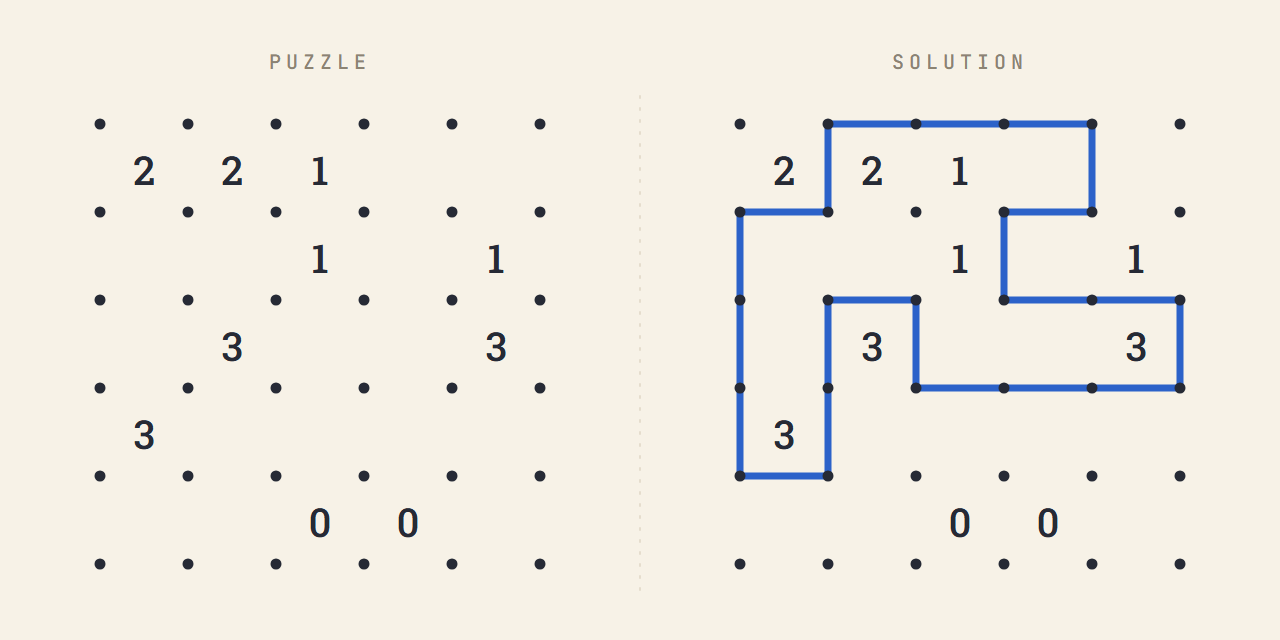
Slitherlink is played on a lattice of dots. Join neighboring dots with horizontal and vertical lines to make a single closed loop. A number in a square says how many of its four sides are part of the loop; a square without a number can have any count. The loop never crosses itself or branches, so every dot ends up with two lines or none. A 0 is a good place to start: none of its four sides can be part of the loop.
Slitherlink came from Nikoli's readers. A teenage student using the pen name Lenin sent in a grid of dots to be joined into one loop, and a member of Nikoli's staff combined it with an idea from another reader, Yuki Todoroki. The puzzle first appeared in June 1989, in issue 26 of Puzzle Communication Nikoli. In that first version every square had a number, and the lines did not have to form a loop. Nikoli is proud of it as one of its originals, and its fans in Japan call it Sli-Lin.
- Invented by: Nikoli, from ideas sent in by two readers
- First printed: Puzzle Communication Nikoli, June 1989
- Play it today: Loopy in Simon Tatham's collection, Puzzle by Nikoli S Slitherlink on Nintendo Switch, and free at puzzle-loop.com
4. Hitori
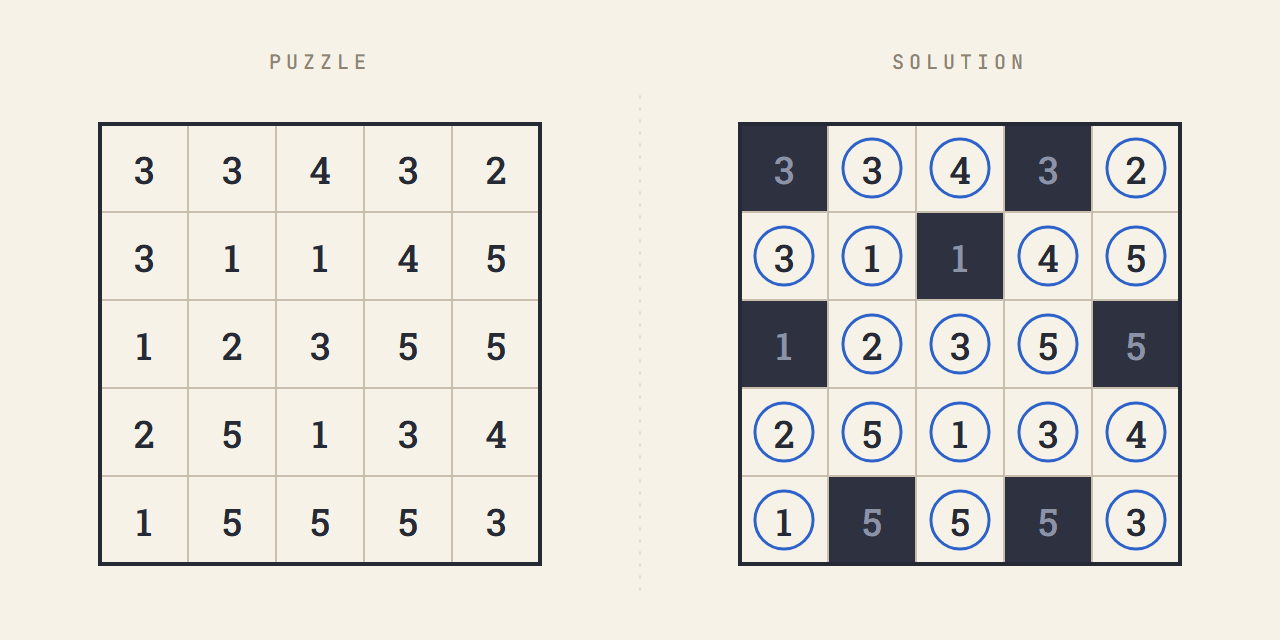
Hitori turns sudoku inside out: the grid starts full of numbers, and you take numbers away. Shade cells until no number appears twice in any row or column. Shaded cells may touch at a corner but never along a side, and all the unshaded cells must stay connected in one piece. Many solvers circle each number they know must stay, as in our solution.
Hitori first appeared in Puzzle Communication Nikoli in March 1990, in issue 29. Its name comes from hitori ni shite kure, Japanese for "leave me alone", which is what every number in it wants: to be the only one of its kind in its row and its column.
- Invented by: Nikoli
- First printed: Puzzle Communication Nikoli, March 1990
- Play it today: Singles in Simon Tatham's collection, Puzzle by Nikoli S Hitori on Nintendo Switch, and free at puzzle-hitori.com
5. Hashiwokakero
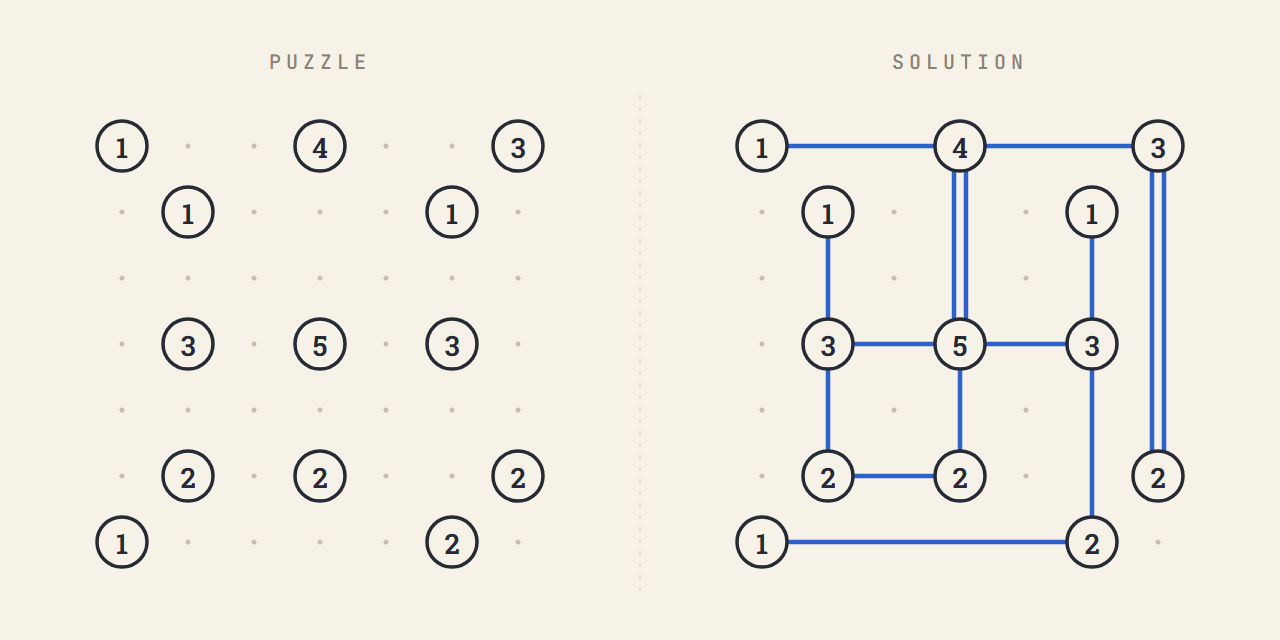
Each circle is an island, and its number is how many bridges end there. Draw bridges as straight horizontal or vertical lines between islands, never more than two between the same pair. Bridges may not cross each other or pass over an island, and in the end all the islands must be joined into one network, so that you could walk from any island to any other.
The name means "build bridges!" in Japanese. The puzzle first appeared in Puzzle Communication Nikoli in September 1990, in issue 31, after an earlier form in December 1989. It was invented by Lenin, the reader whose idea also started Slitherlink. In English it is usually called Bridges, or Hashi, the name The Times printed it under. It has also been sold as Chopsticks, a mistranslation: written with a different character, hashi means chopsticks.
- Invented by: a Nikoli contributor with the pen name Lenin
- First printed: Puzzle Communication Nikoli, September 1990
- Play it today: Bridges in Simon Tatham's collection, Puzzle by Nikoli S Hashiwokakero on Nintendo Switch, and free at puzzle-bridges.com
6. Nurikabe
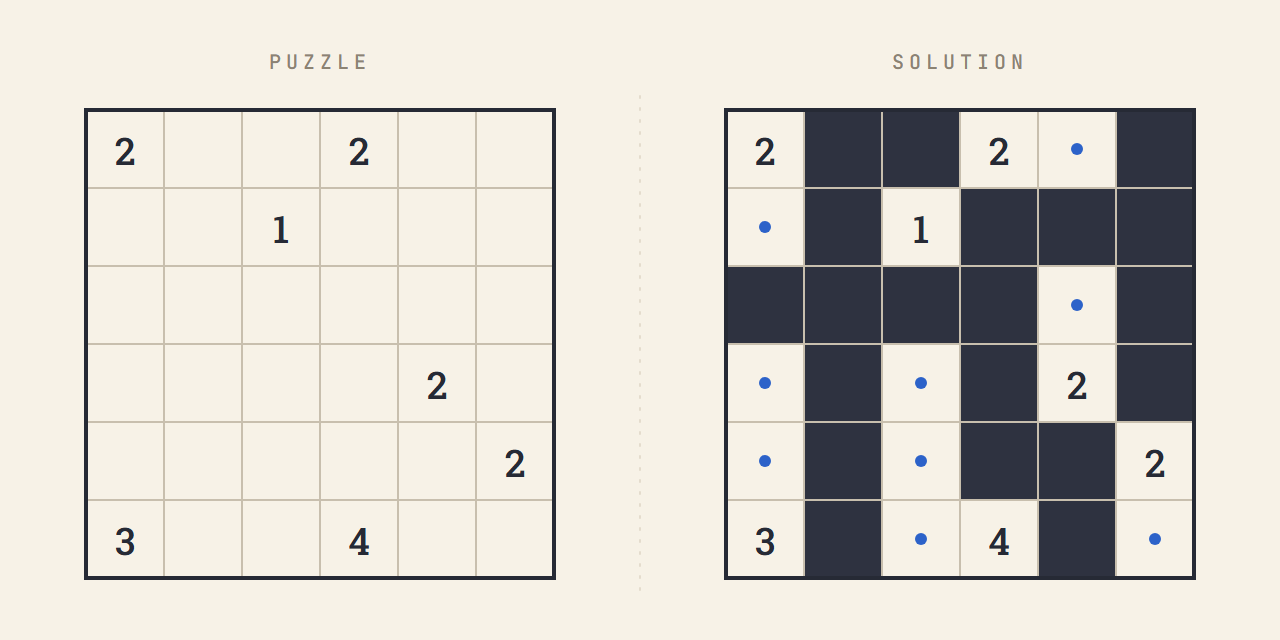
In Nurikabe you build a wall. Shade cells so that each number sits in an island of unshaded cells exactly that big, with one number per island, and islands never touch along a side. All the shaded cells must join into one continuous wall, and the wall may never fill a 2×2 square.
The puzzle is named after the nurikabe, a spirit from Japanese folklore that appears as an invisible wall and blocks the way of travelers walking at night. Lenin invented this one too, for issue 33 of Puzzle Communication Nikoli, in March 1991. It soon caught on: it became a regular with the 38th issue, and by 2005 Nikoli had published seven books of nothing but Nurikabe.
- Invented by: a Nikoli contributor with the pen name Lenin
- First printed: Puzzle Communication Nikoli, March 1991
- Play it today: Puzzle by Nikoli S Nurikabe on Nintendo Switch, and free at puzzle-nurikabe.com
7. Masyu
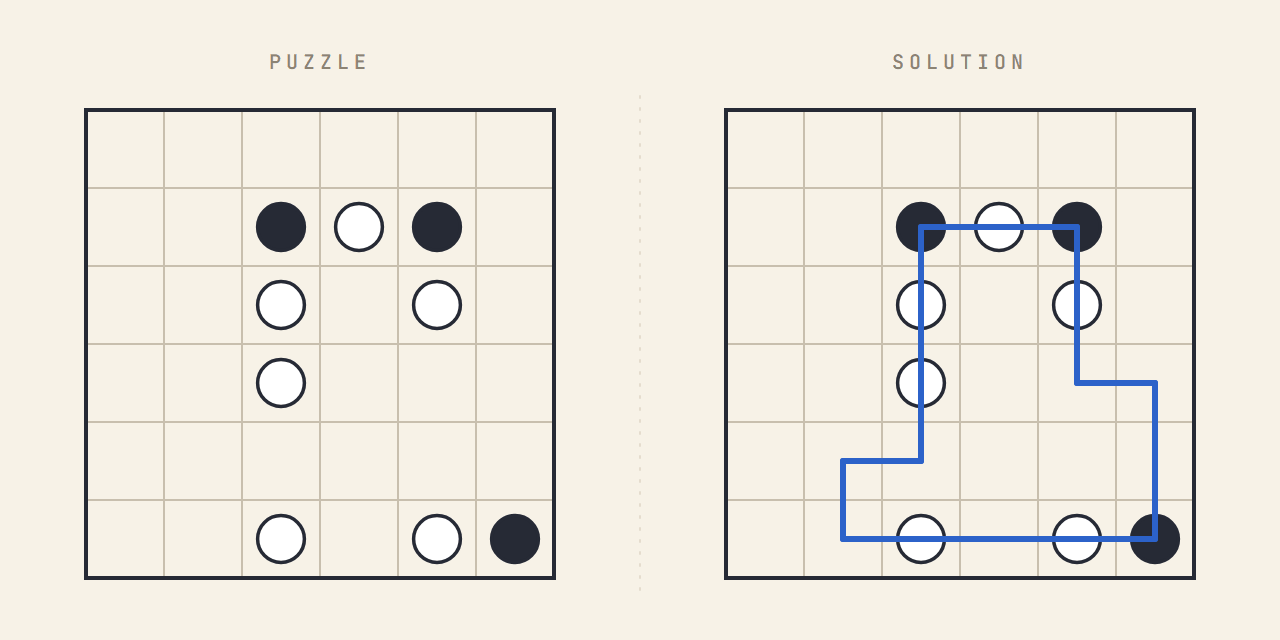
Masyu has no numbers at all. Draw one loop through the centers of cells, moving horizontally and vertically, that never crosses or touches itself and passes through every circle. At a white circle the loop goes straight through, and it must turn in the cell just before or just after it. At a black circle the loop turns, and then it must go straight through the next cell on both sides.
That was the point: Nikoli wanted a puzzle without numbers or letters that still had depth. In 1999 a creator named Ryuoh Yano came up with Pearl Necklace, a loop puzzle with white circles only. Another creator, Acetonitrile, added black circles with a rule of their own, and the new puzzle appeared in 2000 as White Pearl Black Pearl. Then Nikoli's president, Maki Kaji, misread the Japanese characters of its name, and his mistake became an office joke that stuck: masyu means "evil influence".
- Invented by: Ryuoh Yano and Acetonitrile, two Nikoli contributors
- First printed: Puzzle Communication Nikoli, 2000 (a version with white circles only in 1999)
- Play it today: Pearl in Simon Tatham's collection, Puzzle by Nikoli S Masyu on Nintendo Switch, and free at puzzle-masyu.com
8. Akari
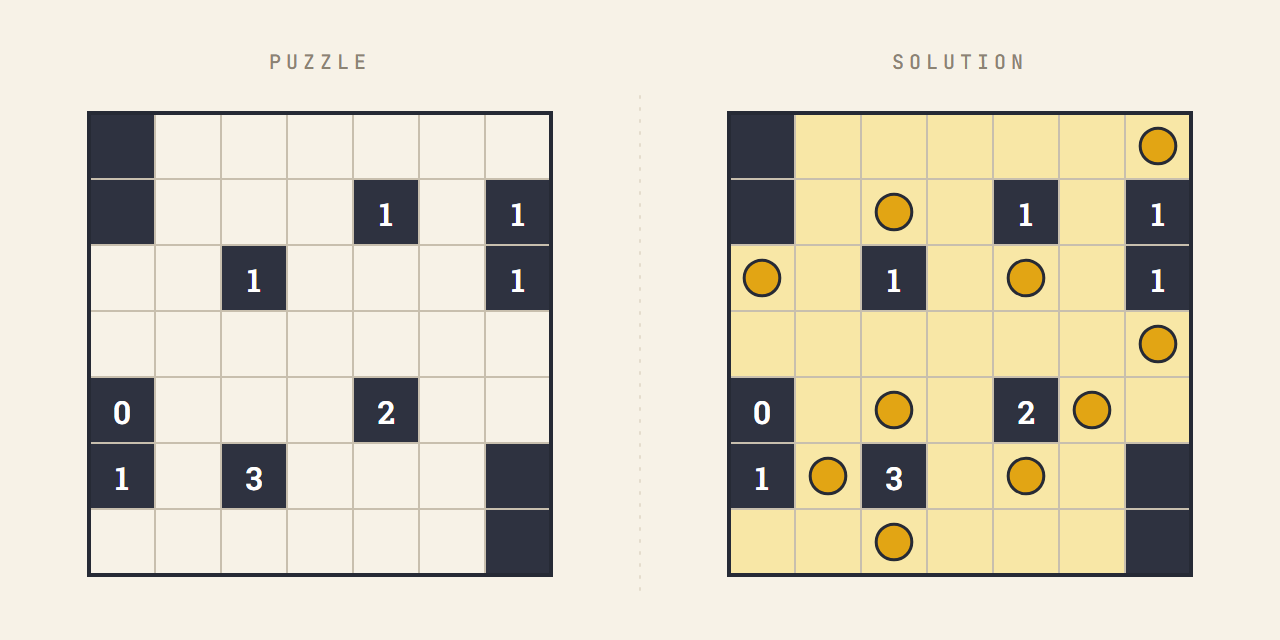
Akari is about light. Place bulbs in white cells so that every white cell is lit. A bulb lights its whole row and column until the light hits a black cell or the edge of the grid, and no bulb may shine on another. A number on a black cell says how many bulbs sit right next to it, above, below, left or right; a black cell without a number may have any number of bulbs around it, or none.
Nikoli developed Akari in 2001. Its Japanese name is Bijutsukan, "art gallery", and in English it is also called Light Up. Like Nurikabe it earned books of its own: by 2011 Nikoli had published three that hold nothing but Akari.
- Invented by: Nikoli
- First printed: Puzzle Communication Nikoli, 2001
- Play it today: Light Up in Simon Tatham's collection, Puzzle by Nikoli S Akari on Nintendo Switch, and free at puzzle-light-up.com
9. Star Battle
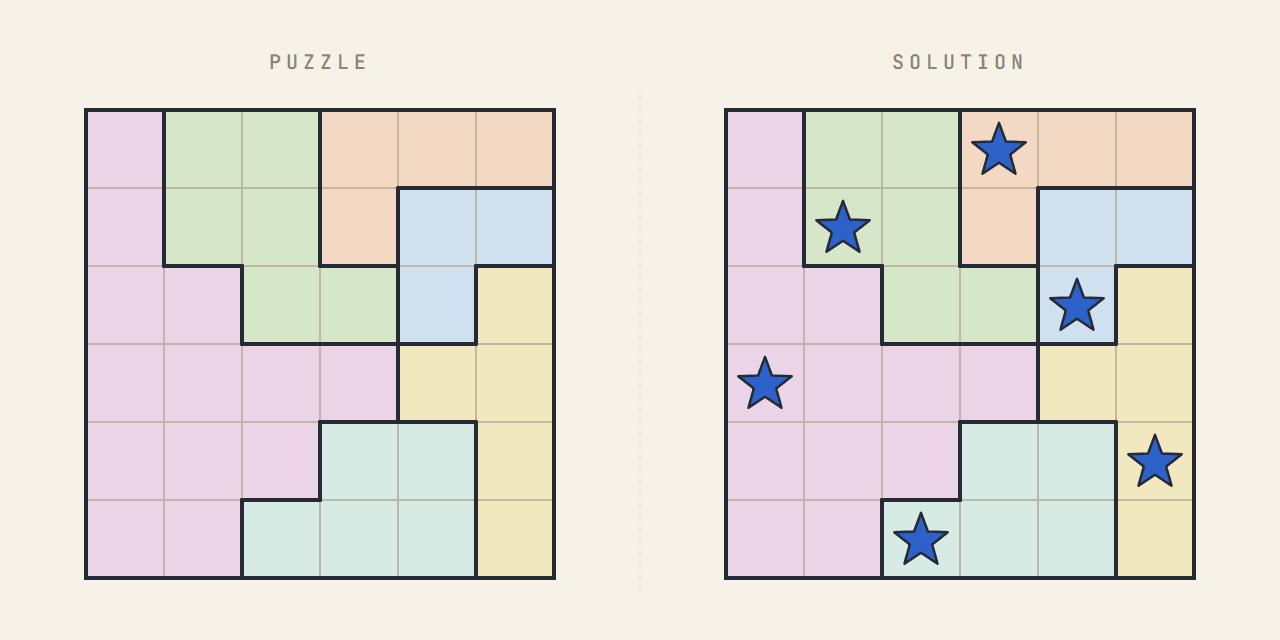
Place stars so that every row, every column and every outlined region holds the same number of stars, and no two stars touch, not even at a corner. Our small example asks for one star in each; the most common version is a 10×10 grid with two stars in every row, column and region.
Star Battle is Dutch. Hans Eendebak created it for the 2003 World Puzzle Championship in Arnhem, in the Netherlands, probably building on Cattle, an earlier puzzle by Tim Peeters. In May 2024 it reached a new audience when LinkedIn launched Queens, a daily game where you place crowns instead of stars. GM Puzzles calls Queens "a very accessible, one-star version of Star Battle puzzles", and the puzzle maker Thomas Snyder made puzzles for its launch.
- Invented by: Hans Eendebak
- First printed: World Puzzle Championship, Arnhem, 2003
- Play it today: Queens, free at linkedin.com/games with a new puzzle every day and no account needed, and free Star Battles at puzzle-star-battle.com
10. KenKen
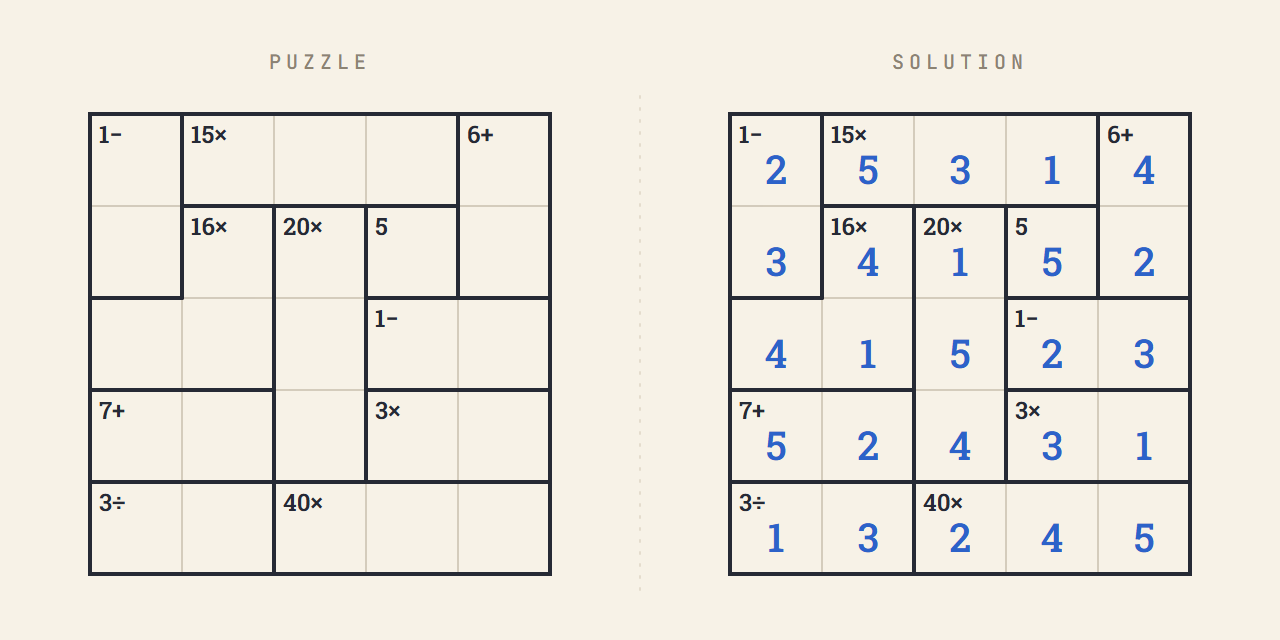
KenKen is sudoku with arithmetic. Fill the grid with the digits from 1 to its size, 1 to 5 in our example, so that no digit repeats in a row or column. Bold outlines divide the grid into cages, and each cage's clue gives a target and an operation: its digits must make the target by adding, subtracting, multiplying or dividing. A digit may repeat inside a cage as long as the repeats are not in the same row or column, and a cage of one cell simply gives you its digit.
Tetsuya Miyamoto, a Japanese math teacher, invented KenKen in 2004 for the students of his math classroom, as a way to train their brains without instructions; he told The New York Times that he believes in "the art of teaching without teaching". The educational publisher Gakken printed his puzzles in Japan as Kashikoku naru Puzzle, "a puzzle that makes you smarter". Ken means cleverness, so KenKen is cleverness squared. The Times of London began printing it in March 2008, and in February 2009 it started in The New York Times, next to the crossword.
- Invented by: Tetsuya Miyamoto
- First printed: Japan, in Gakken's Kashikoku naru Puzzle books; in English, The Times, 2008
- Play it today: free daily puzzles at kenkenpuzzle.com and in the KenKen apps for iPhone, iPad and Android, and Keen in Simon Tatham's collection
Honorable mentions
- Killer Sudoku: sudoku with Kakuro's sums. The grid starts empty and is divided into cages, each showing the total of its digits, and no digit may repeat within a cage. It is usually credited to the Japanese puzzle maker Tetsuya Nishio, and it first appeared outside Japan in The Times in 2005. Simon Tatham's Solo has a Killer mode.
- Futoshiki (2001): Tamaki Seto's puzzle fills a grid like KenKen's, with no digit twice in a row or column, but its clues are greater-than and less-than signs between cells. Its name means "inequality"; The Guardian and The Times print it, and Simon Tatham calls it Unequal.
- Heyawake (1992): Nikoli's "divided rooms". Shade cells to match each room's number, with Hitori's rules about touching and staying connected, plus one more: no straight line of white cells may cross more than two rooms. It has a Puzzle by Nikoli S game too.
- Skyscrapers: fill a grid with towers of different heights, each height once in every row and column; each clue around the edge says how many towers you can see from there, since shorter towers hide behind taller ones. Simon Tatham, who includes it as Towers, does not know who invented it.
Bonus: SudokuGen (our web app)
When you come back to sudoku, try our free web app, SudokuGen. It creates a new puzzle with exactly one solution whenever you ask, from the classic 9×9 up to 16×16 and 25×25, lets you share any puzzle as a link and, once you have opened it online, works offline too. For sudoku games to play, see our list of the 10 best sudoku games.
Everybody has a favorite puzzle after sudoku, and these are ours. Did we miss yours? Tell us
Sources :
- Nikoli: Nikoli's company profile (opens in a new tab), Inside Japan's Cult-Favorite Puzzle Laboratory on Atlas Obscura (opens in a new tab), sudoku at Nikoli (opens in a new tab), Simon Tatham's Portable Puzzle Collection (opens in a new tab)
- Kakuro: Kakuro on Wikipedia (opens in a new tab), Kakuro on GM Puzzles (opens in a new tab), Kakuro's history at Conceptis (opens in a new tab), Kakuro at Nikoli (opens in a new tab), Puzzle by Nikoli S Kakuro (opens in a new tab), puzzle-kakuro.com (opens in a new tab)
- Nonograms: Nonogram on Wikipedia (opens in a new tab), Mario's Picross on Wikipedia (opens in a new tab), Picross S (opens in a new tab), puzzle-nonograms.com (opens in a new tab)
- Slitherlink: Slitherlink on Wikipedia (opens in a new tab), Slitherlink at Nikoli (opens in a new tab), Puzzle by Nikoli S Slitherlink (opens in a new tab), puzzle-loop.com (opens in a new tab)
- Hitori: Hitori on Wikipedia (opens in a new tab), Hitori at Nikoli (opens in a new tab), Puzzle by Nikoli S Hitori (opens in a new tab), puzzle-hitori.com (opens in a new tab)
- Hashiwokakero: Hashiwokakero on Wikipedia (opens in a new tab), Hashiwokakero at Nikoli (opens in a new tab), Puzzle by Nikoli S Hashiwokakero (opens in a new tab), puzzle-bridges.com (opens in a new tab)
- Nurikabe: Nurikabe on Wikipedia (opens in a new tab), the nurikabe of folklore on Wikipedia (opens in a new tab), Nurikabe at Nikoli (opens in a new tab), Puzzle by Nikoli S Nurikabe (opens in a new tab), puzzle-nurikabe.com (opens in a new tab)
- Masyu: Masyu on Wikipedia (opens in a new tab), Masyu on Atlas Obscura (opens in a new tab), Masyu on GM Puzzles (opens in a new tab), Masyu on Japanese Wikipedia (opens in a new tab), Puzzle by Nikoli S Masyu (opens in a new tab), puzzle-masyu.com (opens in a new tab)
- Akari: Light Up on Wikipedia (opens in a new tab), Akari at Nikoli (opens in a new tab), Akari on Japanese Wikipedia (opens in a new tab), Puzzle by Nikoli S Akari (opens in a new tab), puzzle-light-up.com (opens in a new tab)
- Star Battle: Star Battle on GM Puzzles (opens in a new tab), Star Battle on the Puzzles Wiki (opens in a new tab), LinkedIn's games on TechCrunch (opens in a new tab), Queens on GM Puzzles (opens in a new tab), playing without an account (opens in a new tab), puzzle-star-battle.com (opens in a new tab)
- KenKen: KenKen on Wikipedia (opens in a new tab), KenKen's history (opens in a new tab), KenKen's start in The New York Times (opens in a new tab), KenKen (opens in a new tab)
- Honorable mentions: Killer sudoku on Wikipedia (opens in a new tab), Futoshiki on Wikipedia (opens in a new tab), Heyawake on Wikipedia (opens in a new tab), Puzzle by Nikoli S Heyawake (opens in a new tab), Towers in Simon Tatham's manual (opens in a new tab)
Sudoku is a registered trademark of Nikoli Co., Ltd. in Japan, KenKen is a registered trademark of KenKen Puzzle, LLC, and Picross is a trademark of Nintendo; other puzzle, game and app names are trademarks of their owners. The puzzle examples and the pixel-art illustration at the top are our own.
If you like this article,